LMSStudy with AIAvailable now
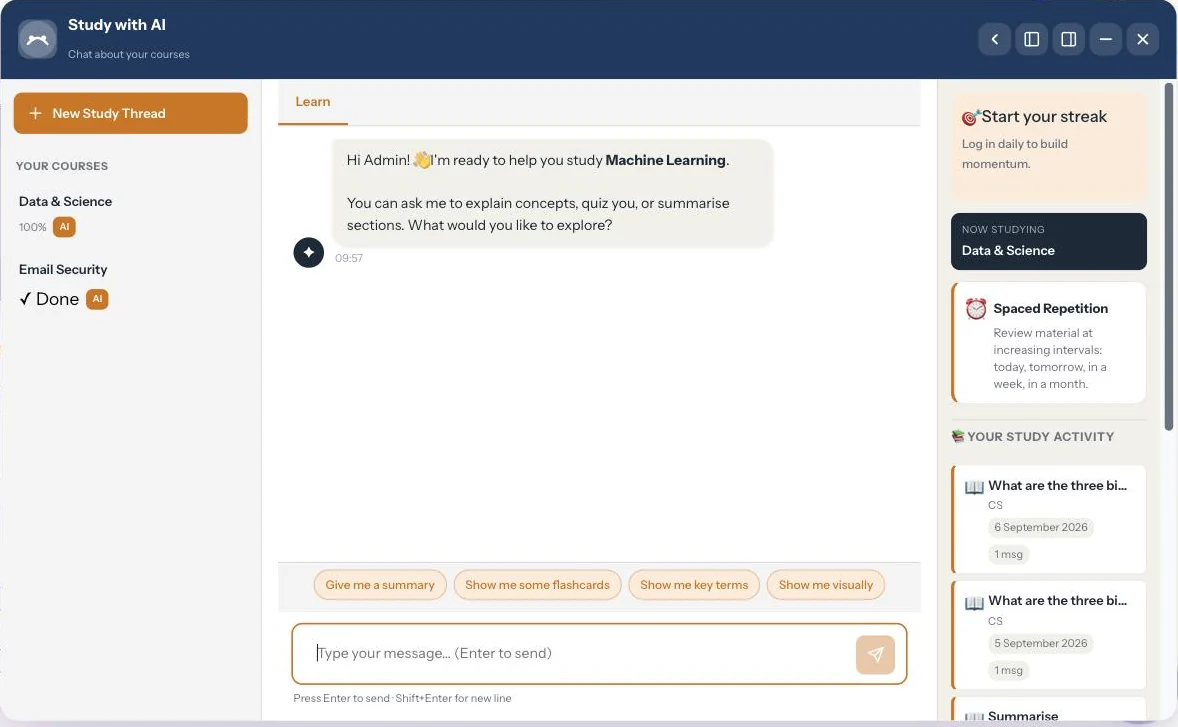
Study with AI is a 24/7 tutor inside edzlms that answers learner questions using only your organisation's deployed course content, citing the specific module or slide it drew from. Questions it cannot answer from your material surface to your L&D team as content gaps rather than being improvised.
Why we built it
The obvious way to add AI to a learning platform is to wire in a general-purpose chatbot. Almost every LMS vendor has now done exactly that, and it has created a problem nobody anticipated: the tutor confidently answers questions your course never covered, using information your organisation never approved.
For a compliance course that is not a minor annoyance. If a learner asks a general model what the notification window for a data breach is, they get a plausible answer. If that answer contradicts the policy in your actual course — the one they will be assessed against, and the one your regulator cares about — you have automated the spread of misinformation inside your own training.
The second problem is subtler. A general chatbot answers and moves on. It does not tell you that eleven learners asked the same question about module four, which is the single most useful signal your content team could receive.
Study with AI is built the opposite way round. It is grounded in your deployed content and nothing else, and every question it receives is treated as data about where your content is failing.
What it does
- On-content answers only. Responses are drawn from the course material you have actually deployed. Ask it something outside that material and it says so rather than improvising.
- Citations back to the source. Every answer references the specific module or slide it came from, so a learner can go and read the thing itself — and a trainer can verify the answer in seconds.
- Adaptive paths. Journeys adjust in real time on performance. Advanced learners get fast-tracked and struggling learners get remedial content inserted automatically, instead of everyone marching through the same fixed sequence.
- Gap detection that reaches your content team. Repeated questions, high error rates and at-risk learners surface as analytics — not just who is struggling but which content is failing them, with auto-nudge for learners who go quiet.
- It works over content you already own, including SCORM. Upload an existing package and the AI layer generates summaries, a glossary, flashcards, practice quizzes, transcripts and note-taking on top of it, with no re-authoring of the course you have already paid to build.
How to turn it on
- Enable Study with AI on the courses you want covered. Scope it per course rather than site-wide, so a pilot cohort can run before full rollout.
- Let it index the deployed content. The tutor reads what is already in the course, including uploaded SCORM packages. There is no separate content preparation step.
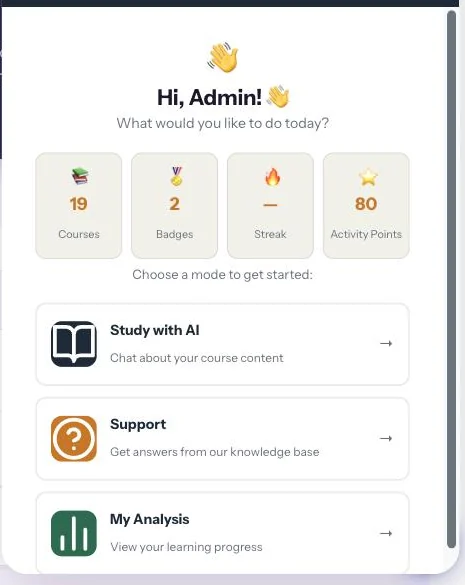
- Point learners at it. It appears alongside the course content, so there is nothing for a learner to install or sign into separately.
- Read the gap analytics weekly. This is the part most teams underuse. It is a content backlog written by your own learners.
Where it fits
A compliance team where the answer has to match the policy. The value here is not convenience, it is containment: a tutor that refuses to answer beyond the approved material is safer than one that answers everything well.
A university supporting a large cohort with finite tutor hours. Most learner questions arrive outside the hours anyone is available to answer them, and the majority are already answered somewhere in the course. A tutor that is awake at 1am and cites the module it drew from returns those hours without lowering the standard of the answer.
These are composite scenarios.
The situations above are drawn from patterns we see repeatedly across corporate and academic deployments. They are illustrative composites, not descriptions of specific customers, and they carry no outcome figures.
Frequently asked questions
How is this different from adding ChatGPT to an LMS?
A general model answers from everything it has ever read. Study with AI answers from the course material you have deployed, and says so when a question falls outside it. In regulated training that boundary is the entire point.
Does it work with courses we have already built?
Yes, including SCORM packages. The AI layer sits on top of existing content and generates summaries, glossaries, flashcards, practice quizzes and transcripts without re-authoring.
Can a trainer check where an answer came from?
Yes. Every response cites the specific module or slide it drew from, so an answer can be verified against the source in seconds.
What happens to questions it cannot answer?
They surface in the analytics as content gaps. Repeated questions on the same topic are the clearest signal you will get about which part of a course is not doing its job.
What's next
The AI study layer over uploaded SCORM packages is the closest adjacent capability — the same grounding principle applied to content you built before you had an AI tutor. That gets its own announcement shortly.
Want to see it answer questions on your own course content?
Book a Free Demo